Grant Shapps is in the headlines after being accused of self-serving edits made to his own entry on Wikipedia, as well as unflattering changes made to rivals’ pages. But he may not be the only politician giving himself a virtual facelift. Analysis of the Twitter account @parliamentedits, which tracks edits to Wikipedia made from inside the Houses of Parliament, shows other attempts to edit the online encyclopedia, many of them controversial.
Continue reading “The MPs whose Wikipedia pages have been edited from inside Parliament”
Category: politics
Radio appearance: Diplomacy on Twitter
My appearance on the Monocle’s The Briefing show, on Wednesday 25th March 2015, to discuss diplomats and politicians on Twitter. [Full episode here]
What the Thornberry Affair tells us about politicians online
Published on the the LSE British Politics and Policy blog.
Many commentators have speculated what was going through the mind of Emily Thornberry, the shadow Attorney General, when she tweeted a picture of a terraced Rochester house draped in three England flags and a white van parked in the driveway, with the simple caption ‘Image from Rochester’. Continue reading “What the Thornberry Affair tells us about politicians online”
The Crowd in the Cloud? Three challenges for gauging public opinion online
Much excitement surrounds the use of social sources of big data – harvested from popular networking platforms like Twitter and Facebook, as well as other forms of socially generated data including Wikipedia edits and Google searches – in the pursuit of social scientific discovery. In this paper I assess the extent to which these newly available sources of socially-generated big data can tell us about public opinion in a society at large. I draw on data from a series of interviews conducted with researchers at the forefront of big data approaches to social science, in order to outline the opportunities and issues around this area of research. In my analysis I identify three challenges to the validity of online public opinion measurement – the reliability of the data collected, the representativeness of the ‘sample’ being analysed, and the replicability of this form of public opinion research – and suggest various ways in which these challenges can be met.
Nationalism and the Scottish Genius
It’s the smell that hits you first. Stepping into Waverley is to step into a wave of malty musk which suffuses your sinuses. Off the platform and into the car, it’s what you feel that gets you next: the juddery drive over improbably cobbly streets. And finally, what you see: Castle Rock and Arthur’s Seat, peaks that, if it’s misty, you might only be able to peek at. Continue reading “Nationalism and the Scottish Genius”
Murder in the time of virality


That the beheading of journalist James Foley is ‘media’ is horrific. Whether it is ‘social’ falls on all of us.
I, like millions of others, learned about the death of journalist James Foley on social media. But it just so happened that the news was delivered to me in as sensitive and sombre a way as possible. Continue reading “Murder in the time of virality”
Social media and public opinion: what’s new?
I’m currently writing up a paper for submission to the Internet, Politics and Policy 2014 conference to be held by the OII in September. My paper – which draws substantially on interviews conducted as part of the Sloan Foundation-funded project of which I’m part – asks whether and to what extent the measurement of public opinion has been transformed by the new availability of socially-generated sources of big data, such as social media postings and search queries, and the tools which allow us to analyse them. Continue reading “Social media and public opinion: what’s new?”
Nick, Nigel, and the Neapolity: The Fragmented Future of British Party Politics


Here are some predictions that I make with a fair degree of certainty. An indifferent British electorate will shrug its collective shoulders and award Nigel Farage’s UK Independence Party the second highest vote total in this May’s European elections. Buoyed by this win, Farage will force his way onto the stage for the party leader debates in 2015. And in the subsequent general election, for the first time in history, four parties will each take more than 10% of the vote nationwide. After trialling an alternative arrangement between 2010 and 2015, the era of big-party government will be over. Continue reading “Nick, Nigel, and the Neapolity: The Fragmented Future of British Party Politics”
Why social data isn’t always a reliable indicator
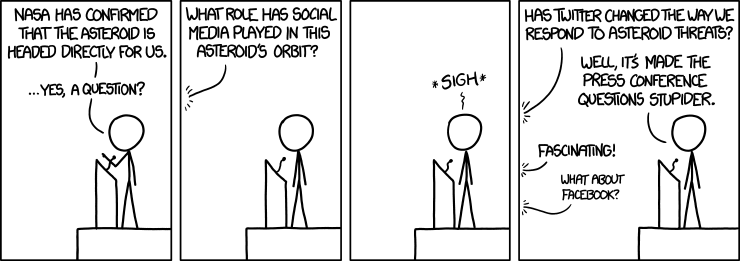

“What social data can tell you: pretty much everything” proclaimed Azeem Azhar, founder of PeerIndex, in a popular post on LinkedIn earlier this week. We can perhaps forgive Azhar the hyperbolic lead-in, but hisarticle as a whole indulges in untrammeled evangelism for social data which obscures much of the nuance and uncertainty regarding what exactly this new source of data can actually tell us about society. Continue reading “Why social data isn’t always a reliable indicator”
“Twitter says…” – Can big social data tell us about public opinion?


“Like Noah’s ark, (there was) every kind of creature in every walk of life. They included a town wit, a grave citizen, a worthy lawyer, a worship justice, a reverend nonconformist, and a voluble sailor.”
The above description comes from a history of English coffee houses in the seventeenth century¹, but might just as well apply to the twenty first century’s sites of caffeinated conversation: online social networks. With the rapid uptake of the Internet and the more recent rise to prominence of social network sites like Facebook and Twitter, hundreds of millions of ordinary people – the witty, the worthy, and the decidedly neither – are now connected not only to the web, a source of news, but also to social networks, a source of views. Continue reading ““Twitter says…” – Can big social data tell us about public opinion?”
 Josh Cowls