
Big Data in Bellagio: who counts, what counts, and how do we count?

photo-2

One of the early discussions emerging at our ‘Big Data for Social Change’ at the Rockefeller Center in Bellagio surrounds how the act of capturing of big data impinges on our understanding of it. There are three strands in particular which have been flagged up. Firstly, who does the counting? As Marc Ventresca has showed, the shift from ecclesiastical to secular authority in the collection of data affected perceptions of society, for example shifting the focus to the individual from the collective. The national census is not an impassive, aloof process but rather a culturally and politically significant object, reflecting and reinforcing societal debate and conflict. This significance is reflected in the 1918 observation that, “the science of statistics is the chief instrumentality through which the progress of civilization is now measured, and by which its development hereafter will be largely controlled”. Continue reading “Big Data in Bellagio: who counts, what counts, and how do we count?”

Preserving the present: the unique challenges of archiving the web

In March 2012, as Mitt Romney was seeking to win over conservative voters in his bid to become the Republican Party’s presidential nominee, his adviser Eric Fehrnstrom discussed concerns over his appeal to moderate voters later in the campaign, telling a CNN interviewer, “For the fall campaign … everything changes. It’s almost like an Etch A Sketch. You can kind of shake it up, and we start all over again.” Fehrnstrom’s unfortunate response provided a memorable metaphor for the existing perception of Romney as a ‘flip-flopper’. Fehrnstrom’s opposite number in the Obama campaign, David Axelrod, would later jibe that “it’s hard to Etch-A-Sketch the truth away”, and indeed, tying Romney to his less appetising positions and comments formed a core component of the President’s successful re-election strategy. Continue reading “Preserving the present: the unique challenges of archiving the web”

Piecing Together the Value of Big Data

Image
The multi-tiled Kuggen building, part of Chalmers’ Lindholmen campus

During the construction of a jigsaw or model, there is invariably a moment in which one’s perception shifts from the level of ‘parts’ to the level of ‘whole’ – when, as it were, the bigger picture becomes clear. (Presumably the German language offers an elegant compound noun for this, but I am yet to come across it.) Since its ascension from first appearance to its current perch at the peak of inflated expectations, big data as a phenomenon has seemed to operate primarily on the level of parts or pieces. These usually take the form of noteworthy findings from or utilisations of big data that are eye-opening for one reason or another. Continue reading “Piecing Together the Value of Big Data”

Nick, Nigel, and the Neapolity: The Fragmented Future of British Party Politics

Image

Here are some predictions that I make with a fair degree of certainty. An indifferent British electorate will shrug its collective shoulders and award Nigel Farage’s UK Independence Party the second highest vote total in this May’s European elections. Buoyed by this win, Farage will force his way onto the stage for the party leader debates in 2015. And in the subsequent general election, for the first time in history, four parties will each take more than 10% of the vote nationwide. After trialling an alternative arrangement between 2010 and 2015, the era of big-party government will be over. Continue reading “Nick, Nigel, and the Neapolity: The Fragmented Future of British Party Politics”

Why social data isn’t always a reliable indicator

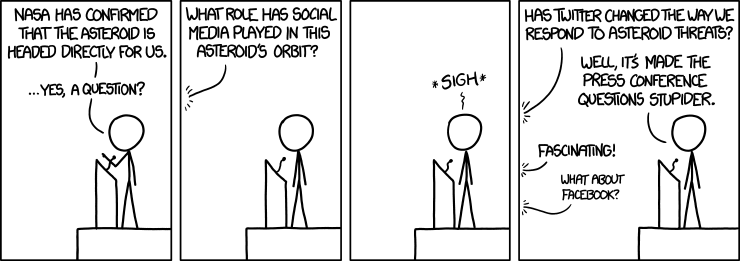
From XKCD

“What social data can tell you: pretty much everything” proclaimed Azeem Azhar, founder of PeerIndex, in a popular post on LinkedIn earlier this week. We can perhaps forgive Azhar the hyperbolic lead-in, but hisarticle as a whole indulges in untrammeled evangelism for social data which obscures much of the nuance and uncertainty regarding what exactly this new source of data can actually tell us about society. Continue reading “Why social data isn’t always a reliable indicator”

Review: ‘Inside Llewyn Davis’

“Just exist?” laments the title character in the Coen brothers’ latest treatise on American society. Yet existing is the most appropriate – perhaps the only appropriate – description of the character of Llewyn Davis. Pervasive ennui is not, of course, anything new for a Coen brothers’ film. But here it is taken up a notch – Davis has none of the piety of Larry Gopnik in ‘A Serious Man’, nor the brash self-confidence of The Dude in ‘The Big Lebowski’. Llewyn Davis’s raison d’etre is music – folk music, to be precise – and the film contains probably an album’s worth of heartfelt renditions, most performed as live. Continue reading “Review: ‘Inside Llewyn Davis’”

“Twitter says…” – Can big social data tell us about public opinion?

coffee house

“Like Noah’s ark, (there was) every kind of creature in every walk of life. They included a town wit, a grave citizen, a worthy lawyer, a worship justice, a reverend nonconformist, and a voluble sailor.”

The above description comes from a history of English coffee houses in the seventeenth century¹, but might just as well apply to the twenty first century’s sites of caffeinated conversation: online social networks. With the rapid uptake of the Internet and the more recent rise to prominence of social network sites like Facebook and Twitter, hundreds of millions of ordinary people – the witty, the worthy, and the decidedly neither – are now connected not only to the web, a source of news, but also to social networks, a source of views. Continue reading ““Twitter says…” – Can big social data tell us about public opinion?”

The new ‘power of now’ and the perils of the hyper-present

With modern technology, living life ‘in the moment’ has never been easier. But this new nowness is far from what earlier advocates had in mind, and might only be distracting us from the planet’s ever more pressing challenges. Continue reading “The new ‘power of now’ and the perils of the hyper-present”

Cyber-revisionism: Parties’ Attitudes to Web Archiving Are a Worrying Sign for Digital Democracy

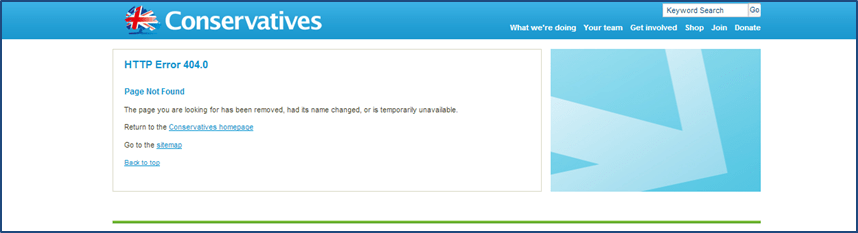
ImageFollowing an earlier, somewhat rantier post on this blog when the news originally broke, I’ve written a more academically-oriented piece on British political parties’ cyber-revisionism with Mor Rubenstein, a current MSc student here at the OII. This was published yesterday on the LSE Politics and Policy blog, and you can read it here. Mor’s undergraduate work on political parties on Facebook provided a useful counterpoint to party websites, and unearthed some deep ironies regarding the (dis)integration between the two platforms and some of the unintended consequences.

(The eagle-eyed may notice that the ‘Fahrenheit 401’ hook in the original post became ‘Fahrenheit 404’ – a less phonaesthetically evocative contrast with Bradbury’s 451 but more accurate, technically speaking…)

Big Data’s People Problem

Big Data Debate

To Google Campus in east London to hear what a number of practitioners thought were the most controversial questions surrounding the use and abuse of big data. After a couple of lightning pitches from big data startups (if you dream of using augmented reality to make your exercise regime more exciting, you’ll be in luck when Google Glass is released) the event moved into a wide ranging panel discussion with participants including journalist Paul Bradshaw, Daniel Hulme, founder of Satalia and Duncan Ross, Director of Data Science at Teradata. The event was billed as tackling the controversial questions over big data, and the panelists got right down to business, eschewing talk of big data’s big potential in favour of honest reflection about the darker side of the data revolution. Continue reading “Big Data’s People Problem”